



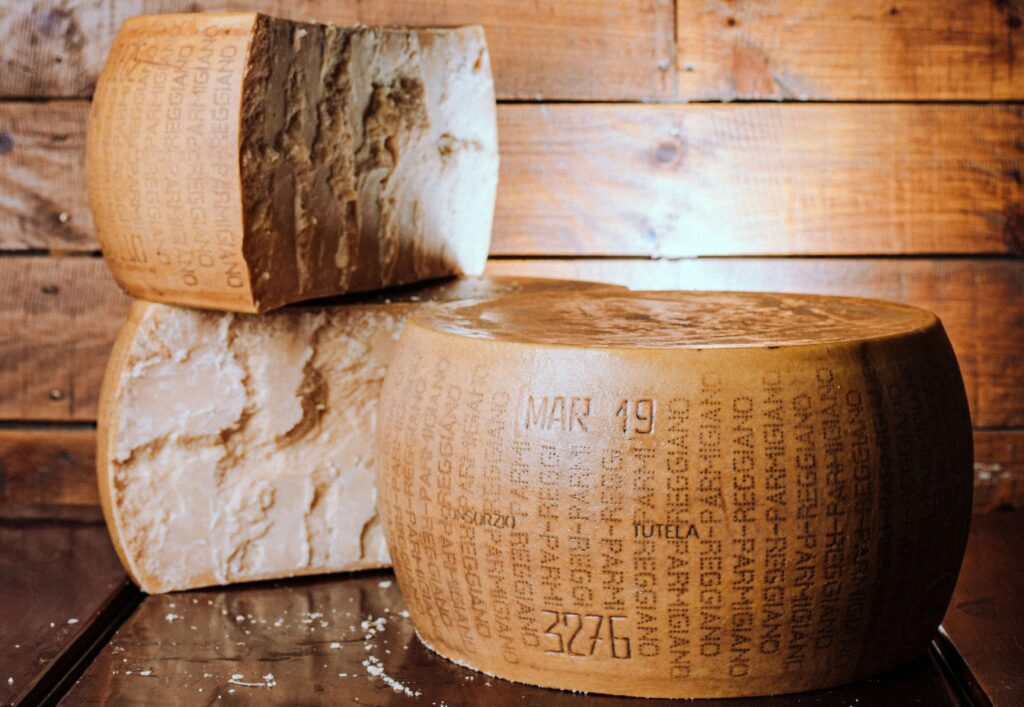
For international food buyers, choosing between Grana Padano and Parmigiano Reggiano is not simply a question of taste. Both are iconic Italian PDO hard cheeses, but differences in production, maturation, sensory profile and positioning can have a direct impact on purchasing decisions, foodservice applications and profitability.
Two PDO cheeses, different specifications
Both cheeses are made from cow’s milk, but their production specifications differ. One of the most relevant differences is maturation: Grana Padano PDO can be released after a minimum of 9 months, while Parmigiano Reggiano PDO requires at least 12 months. Longer ageing develops increasingly complex aromas, firmer textures and more pronounced flavours in both cheeses.
Their production areas also differ: Grana Padano covers a wider area of Northern Italy, while Parmigiano Reggiano is produced within a more restricted PDO territory. For international buyers, these geographical specifications are an important guarantee of origin and traceability.
Price, positioning and professional use
Grana Padano is generally positioned as the more accessible option, making it particularly suitable for high-volume foodservice, retail ranges and applications where cheese is primarily used as an ingredient.
Parmigiano Reggiano generally occupies a more premium position, supported by its distinctive geographical identity, longer minimum maturation and strong international recognition. In 2024, exports accounted for 48.7% of Parmigiano Reggiano sales, reaching 72,440 tonnes.
From a purchasing perspective, the key question is therefore not simply which cheese costs less?, but which product offers the right balance between price, positioning and intended application.
Sensory profile and functionality
Maturation also influences how the cheeses perform in professional kitchens.
Younger Grana Padano has a delicate, milky profile and relatively soft texture, while longer ageing produces a more pronounced flavour and granular structure. Parmigiano Reggiano develops a particularly complex and intense profile as it matures, with a crumbly, grainy texture at longer ageing stages.
This makes maturation a functional consideration as well as a sensory one: a younger cheese can work well in high-volume applications, while a more mature product can deliver greater flavour impact using smaller quantities.
Shelf life, format and logistics
For international distribution, both cheeses offer an important advantage over fresh dairy products: their maturation and hard texture allow for relatively long storage and flexible distribution. However, format matters. Whole wheels offer flexibility for professional cutting, while vacuum-packed portions simplify retail and foodservice handling. Grated products provide convenience but require greater attention to packaging, moisture and oxidation.
For Southeast Asian markets, where products may travel long distances and pass through several distribution stages, buyers should consider format, cold-chain management and stock rotation alongside purchase price.
The opportunity in Southeast Asia
The growing international appeal of Italian cuisine is creating opportunities for both cheeses across Southeast Asia, particularly in Italian restaurants, hotels, modern retail and premium foodservice. For buyers, the two products do not necessarily compete. They can play complementary roles within the same portfolio: Grana Padano can address broader, value-oriented and high-volume segments, while Parmigiano Reggiano can support premium positioning and provenance-led propositions.
This distinction is particularly relevant in markets where consumers may know “Parmesan” as a category but are less familiar with the differences between authentic Italian PDO cheeses.
Grana Padano vs Parmesan: why terminology matters
For international buyers, Parmigiano Reggiano and “Parmesan” should not automatically be treated as interchangeable terms. Within the EU, “Parmesan” is considered evocative of Parmigiano Reggiano and is reserved for the authentic PDO product. Outside the EU, regulations can differ, making country-specific labelling and product requirements important considerations.
PDO certification therefore represents more than a quality mark: it provides origin, production standards and a clear point of differentiation.
There is no universal winner in the Grana Padano vs Parmesan debate. The right choice depends on the target market, channel, price positioning, application and expected stock rotation. Grana Padano can be particularly attractive when versatility, accessibility and cost efficiency are priorities. Parmigiano Reggiano can offer stronger premium positioning where provenance and recognised Italian authenticity are key purchasing drivers.
For Southeast Asian buyers, the strongest opportunity may lie in using both strategically, matching ageing, format and price point to the needs of different market segments.