



Italian Pasta Shapes Buyer’s Guide: Choosing a Shape Is a Business Decision, Never a Stylistic Choice
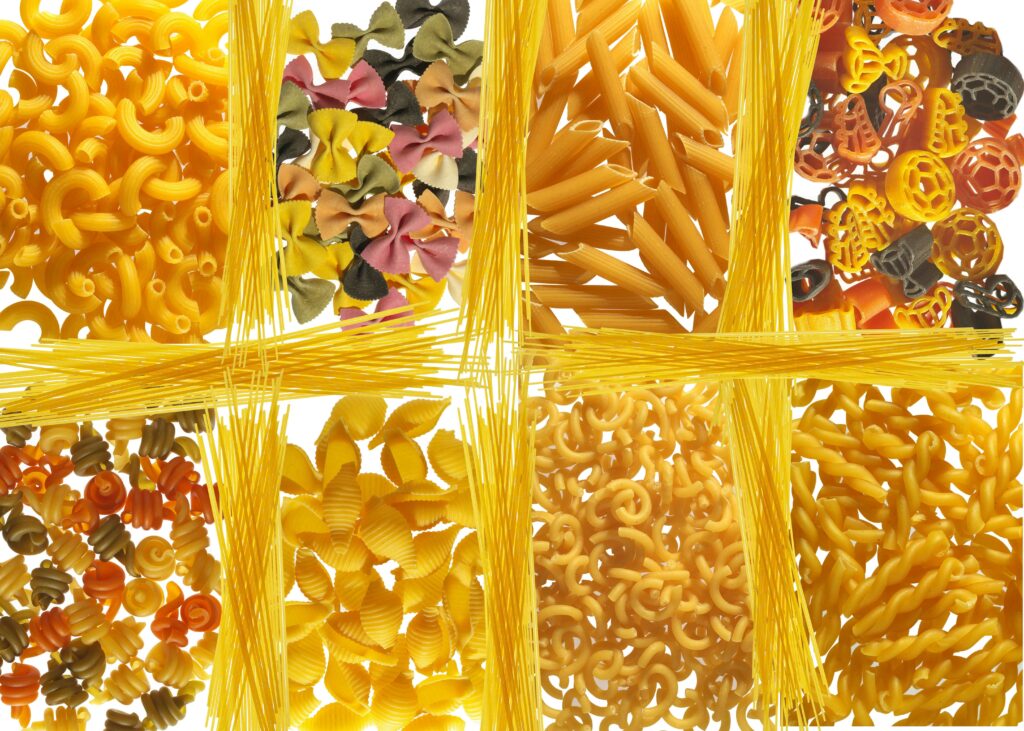
In Italy, no one picks a pasta shape at random. When a Neapolitan grandmother reaches for paccheri instead of penne, it is practical wisdom passed down through generations: that shape holds her sauce exactly the way she wants it held. Across the peninsula there are more than 300 traditional shapes, and not one is decorative. Every one was designed for a purpose.
For cross-border buyers, the same logic applies commercially. Shape determines whether pasta holds its sauce, whether it catches the eye on a supermarket shelf, and ultimately where the product sits in the market, mass-market staple or mid-to-high-end specialty.
Understanding how Italians choose shapes is the first step to building an assortment that sells in your own market, especially where local eating habits differ sharply from Italy’s.
Long pastas: spaghetti, spaghettini, linguine, bucatini, tagliatelle, mafaldine, are built to let sauce wrap around and cling to the surface. Spaghetti remains the most versatile pasta in the world, at home with tomato, seafood, oil-based sauces and classics such as carbonara.
Linguine is a natural match for seafood and pesto: its flat strands carry the sauce instead of letting it sink to the bottom of the plate. Wider ribbons such as tagliatelle were made for hearty preparations: only that surface area supports a rich ragù or cream sauce.
Short pastas: penne, fusilli, rigatoni, farfalle, conchiglie and dozens more — work on the opposite principle. Their ridges, hollow centres and folds exist to trap sauce rather than simply coat it. Penne rigate and fusilli catch the meat and diced vegetables in chunky sauces.
Larger tubes such as rigatoni and paccheri withstand long baking without turning mushy, and their cavities fill with cheese sauce.
The split matters commercially, not only in the kitchen. By weight, short pasta accounts for roughly 70% of Italian production against 30% for long formats. Yet spaghetti is Italy’s export calling card, proof that the domestic bestseller and the international icon are rarely the same product.
Spaghetti and penne dominate Italian consumption. With their main variants, spaghettini, spaghettoni, pennette, mezze penne, they account for the vast majority of domestic sales.
Fusilli and rigatoni follow among short shapes, with linguine and other long formats completing the standard range.
For buyers, these are the foundation. Where Italian cuisine is already established, familiar formats guarantee turnover: customers recognise them, pick them up and check out with confidence. They need no shelf-talker to explain what they are.
Additional margin rarely comes from those staples. Less mainstream shapes are what give a premium assortment regional character, a story to tell, and separation from competitors stocking only the basics.
Mafaldine is a good example, also called mafalde or reginette. Long, flat ribbons with ruffled edges, originally from Naples, they stand out immediately among plainer long shapes while holding sauce securely: rich tomato ragù, seafood, cream. They also photograph beautifully, a tangible advantage in markets where new products gain traction through restaurant menus and social media.
Shapes like these never replace the staples. They complete them and customers will pay more for something they cannot find everywhere else.
What does the Southeast Asian market tell us?
Southeast Asia is an increasingly important destination for Italian pasta. In 2024, Italy exported roughly 2.1 million tonnes of plain, unfilled pasta worldwide, worth around €3.18 billion. The leading regional markets by import value:
- Singapore — €9.1 million / 5.28 million kg
- Thailand — €8.3 million / 5.41 million kg
- Vietnam — €5.8 million / 4.72 million kg
- Philippines — €5.3 million / 3.49 million kg
- Malaysia — €4.8 million / 3.36 million kg
- Indonesia — €2.2 million / 1.19 million kg
Data compiled by the World Bank from UN Comtrade.
One caveat: trade statistics classify pasta by broad customs category, not by individual shape, so they cannot tell you how many tonnes of spaghetti, penne or fusilli each market imported.
Combined with consumption patterns and global recognition, however, they support the International Pasta Organization’s finding that spaghetti, penne rigate and fusilli rank among the world’s most popular formats, the items that carry volume across the region.
The opportunity runs in two directions. Mainstream shapes drive volume, rotation and acceptance. Regional shapes drive value, storytelling and premium positioning. A successful Italian pasta assortment needs both, mixed in the proportion your market will accept, securing the core while earning the premium on top.